
News and Insights
Latest News and Insights
The Story of Mankind, Construction, and Civil Engineering, Told by A Builder
“Could you think of a world without construction?”
This was the question posed by DMCI Founder and Chairman Emeritus David M. Consunji to a group of newly hired engineers during a Quality of Work Life Seminar (QWS), a two-day program designed to help employees better understand their profession, their responsibilities, and the company they had joined, nearly twenty years ago.
In his speech, David reflected on the evolution of construction, from when cave dwellings were first built by our ancestors down to how they formed communities and needed roads, utilities, and public places to live in comfortably. He noted that for centuries the industry relied on trial and error until the advent of civil engineering which made it possible to plan, design, and build structures with certainty.
He acknowledged that construction can be dirty, difficult, and very hazardous, yet he emphasized that it is also one of the most fulfilling professions because of its lasting impact on society. And that if any of them didn’t love construction by the end of the session, then maybe they should look for another career.
Much has changed since then. Technologies have evolved, engineering practices have advanced, and society’s expectations have grown. Yet the challenge remains the same: How do we build better structures and deliver better services to the communities we serve?
-----
THE STORY OF MANKIND, CONSTRUCTION, AND CIVIL ENGINEERING (A Speech by David M. Consunji)
Editor's Note: The following speech by David M. Consunji was delivered to newly hired engineers during a Quality of Work Life Seminar on February 3, 2007. The text has been lightly edited for grammar and readability, while preserving the author's original message and intent.
Adam & Eve were driven out of paradise. They had to start living through the sweat of their brow.
1. To live, they had to hunt, fish, and find plants for food and construct structures and/or dig caves to protect themselves from the weather and from wild animals.
2. In the course of time, people got wiser and so established agriculture and permanent abodes. Then they learned to build better structures with better materials and systems. Since then, construction of structures has been as important an activity as searching for food.
3. In due time, man’s undying ambition to live better prevails, and so after having enough food, he builds better structures for his comfort and progress. Also, people being social animals, to make their lives easier, come to live socially in communities. But living in communities generates common problems, especially in the building of needed structures.
4. While the food and clothing needs of the individual for living are solved generally by the individual himself, the structural needs of the community like transport, utilities, community facilities, parks, museums, communication, etc. are expensive and are generally solved by building common structures.
5. In due time, about the mid-18th century, people of the world solved many structural systems problems through the achievement and acknowledgement of the Civil Engineering Profession. And since then, trial and error has been limited to purely experimental work, like building structures for space travel. Everything else can be planned, designed, and built with confidence.
You, as young engineering graduates, struggled for many years in school to learn how to plan and design the best structures needed by a community. Now you are going to learn how to properly build, what you studied in school. You should understand better your engineering theory as you watch the structures you build grow.
Other professions, like doctors, lawyers, and salesmen, exist to meet our health, social, and economic needs. But, none of them could be as important as Civil Engineering as far as improvement in our standard of living is concerned. As a matter of fact, the standard of living of people is measured by the quality and kind of structures one builds and uses for himself. Definitely, since the beginning of time, construction has been our life-sustaining effort without which there cannot be hope for world progress. Could you think of a world without construction?
This is the historical background of construction and its importance. Remember, prior to Civil Engineering, there already was an existing construction activity. But, the construction then was generally done only after a more or less successful precedent, and any new kind of structure was built by trial and error. No wonder many famous pre-18th century structures like St. Peter’s Basilica and Notre Dame Cathedral took a century or more to finish, and the dome of the Hagia Sophia in Istanbul collapsed and had to be rebuilt, all through trial and error. But, despite building by trial and error, history shows that building structures has always been mankind’s main hope for progress.
My reason for giving you this historical background of Mankind, Construction, and Civil Engineering is to enable all of you to appreciate and to love more your chosen profession and be competitive in building structures. Hoping that in the future this knowledge would make it easier for you to discipline yourselves to help build a globally competitive construction industry as soon as possible. Book knowledge of engineering is not enough in order to excel and make a difference in construction. One must also understand and experience Construction Management and Engineering.
Now let us look at the Civil Engineering profession as practiced in the Philippines today.
The Philippine Institute of Civil Engineers (PICE) has designated five (5) specialty disciplines.
1. Geotechnical - study of our earth and foundations for different purposes.
2. Structural - the art and science of designing and planning structures. The theory and the practice. You have learned the theory in school. Now the practice or the art.
3. Hydraulics, water supply, irrigation, flood control, shore protection, etc.
4. Transportation planning and designing of structures and systems for movement of goods and services.
5. Construction management and engineering. The transporting and fixing of construction materials.
Many times, each discipline affects the others. While each discipline is a specialty, it is worth your while to keep in touch with all the disciplines to be able to establish yourselves as Civil Engineering professionals and be builders. Keep improving your knowledge and understanding. The construction of a simple structure like a concrete high rise building in Makati would need a soil test, structural designer, and construction manager. A more complicated structure like a national highway from Aparri to Zamboanga will surely require the knowledge of all the five specialties to be able to solve the different problems, due to the different sites and physical situations.
Hopefully, the above will give you all enough to love construction, notwithstanding that it is dirty, difficult, and dangerous. To me, construction is fulfilling: there is adventure in searching for the best way, besides the joy of witnessing the gradual completion of a useful and beneficial structure. As you go through the different chores, you shall learn how to make construction cleaner, easier, and safer. Construction can be very simple, or you can make it difficult. The construction activities, systems, and processes respond to laws of nature and society, from excavating, to transporting and fixing of construction materials. Construction is a think and do activity. If you do not prepare for it, construction becomes expensive and awkward. What you shall learn are the acceptable systems and processes from traditional construction. More importantly, you must love it and like doing it. Otherwise, you might as well change careers. Again, to accomplish anything, one must love what one does. Now let us talk a bit about how to construct!
The first step in construction is to know and understand the plan of the structure, its specifications, and other requirements. Then, get to know the construction site. Make a summary of the quantities and the quality of materials needed. Find out how best the materials would be transported and fixed. In other words, how to build the best way is what you shall learn. So far, I have given you an idea of what construction is and most importantly why we construct. I presume knowing why we build would help us to understand deeper the meaning of construction activity and our Civil Engineering profession. Knowing how to build better is a continuing dream and a life challenge.
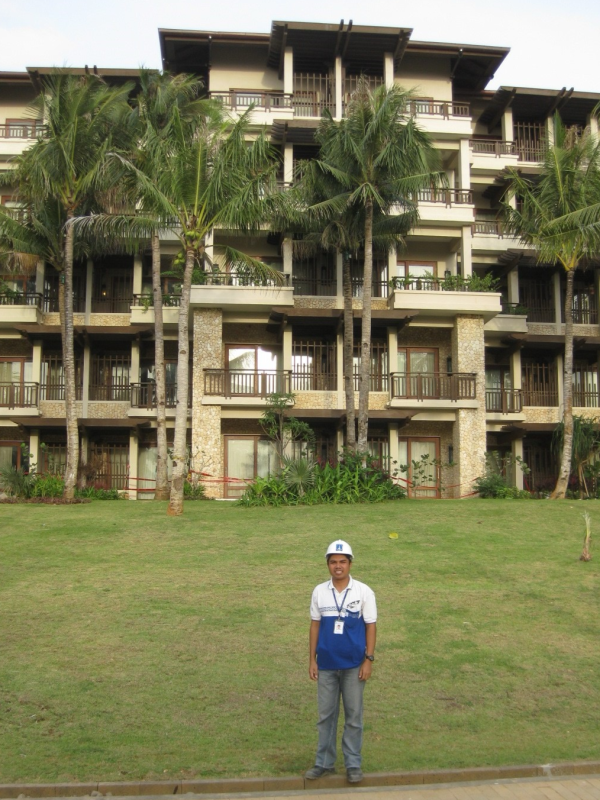
Raphael T. Socion, DMCI Senior MEP Manager at Shangri-La's Boracay Resort and Spa in 2009.
LESSONS THAT ENDURE (Insights by Raphael T. Socion)
I first heard the speech of Founder David M. Consunji (DMC) during the DMCI Quality of Work Life Seminar for newly hired engineers, in which I was also a participant. A copy of the speech was distributed to all attendees during the training. Although the speech was delivered in 2007, its message has remained with me throughout my career. The statement that resonated most was that "life is a continuing learning process." At that time, I understood it as a reminder to keep studying and improving my technical knowledge. However, as I gained more experience, I realized that learning extends far beyond the classroom. As a working professional, your teachers may be your supervisors, mentors, colleagues, or even the challenges you encounter along the way. Every project, challenge, success, and even failure presents an opportunity to grow both professionally and personally.
Another lesson I took from the speech was the importance of hard work, loving what you do, maintaining a healthy body and mind, and developing good character. Early in my career, I often focused on acquiring technical skills and completing tasks. As the years passed, I came to appreciate that long-term success is not determined by competence alone. It also depends on discipline, integrity, perseverance, and the ability to work well with others. These values have helped me navigate the responsibilities and challenges of my profession.
Now, almost twenty years after that speech was delivered, I find myself reflecting on its relevance in today's rapidly changing world. One realization that stands out is the importance of innovation and continuous improvement. As engineers, we are constantly looking for better, safer, and more efficient ways to accomplish our work. Technology continues to evolve, and people's desire for a more comfortable and productive life drives innovation in every industry. This reinforces the idea that learning should never stop, because staying relevant requires us to adapt, embrace new ideas, and continuously improve the way we work.
Looking back, I now appreciate the wisdom in DMC’s message even more than when I first heard it. What seemed like simple advice to a young engineer has become a guiding principle in my career. His words serve as a reminder that professional growth is a lifelong journey built on continuous learning, hard work, good character, and a willingness to innovate and adapt to change.
----
A LEGACY THAT CONTINUES TO INSPIRE
As D.M. Consunji, Inc. (DMCI) continues to build projects that contribute to national development, it also carries forward the values championed by its founder. Every project presents an opportunity to learn. Every challenge creates an opportunity to improve. And every generation of engineers contributes to the collective knowledge and experience that drive the company forward.
The structures David helped build continue to stand as visible symbols of his contribution to society. Equally enduring, however, is the legacy he left in the people he mentored and inspired. Through their work, his belief in excellence, lifelong learning, and love for the profession continues to shape the future of construction.
Construction has always been essential to human progress. The responsibility now rests with today's builders to continue that work and build even better for the generations that follow.
ABOUT THE AUTHOR
Christine Ave V. Tragura, MBA, CLSSYB
Ave is a licensed Civil Engineer with over 16 years of international engineering and infrastructure experience across the construction, oil and gas, mining, manufacturing, and energy sectors in the Philippines and Singapore. She is currently serving as Digital Communications Senior Supervisor at D.M. Consunji, Inc. (DMCI).
More News
September 28, 2026
Success Stories - Early Contractors' Involvement (ECI) with Pioneer Insurance and Surety Corporation
September 24, 2026
Breaking Through: MMSP CP 102 NDJV Achieves Tunnel Breakthrough Milestone
September 21, 2026
Technical Insights Series Article 5 - The Role of Building Information Modeling (BIM) in Modern Construction
All News
The Story of Mankind, Construction, and Civil Engineering, Told by A Builder October 19, 2026
Success Stories - Early Contractors' Involvement (ECI) with Pioneer Insurance and Surety Corporation September 28, 2026
Breaking Through: MMSP CP 102 NDJV Achieves Tunnel Breakthrough Milestone September 24, 2026
Technical Insights Series Article 5 - The Role of Building Information Modeling (BIM) in Modern Construction September 21, 2026
History in the Making: DMCI Joins the Metro Manila Subway Project's CP109 Groundbreaking Ceremony September 18, 2026
Technical Insights Series Article 4 - Typhoon-Resilient Structures: Designing for Extreme Weather September 14, 2026
Lessons From Diego Garcia: A Conversation with Engr. Ronaldo Elepaño Jr. August 18, 2026
Excellence in Action: DMCI's Successful 4th ISO Surveillance Audit August 14, 2026
St. Luke’s Medical Center-QC New Hospital Building Project Achieves 3 Million Safe Manhours without a Lost Time Incident (LTI) August 8, 2026
Engineering Lessons from DMCI's Experience in Diego Garcia August 5, 2026
Celebrating 5 Million Safe Manhours at the 88 MLD Las Piñas Water Reclamation Facility Project July 31, 2026
DMCI Mid-Year Planning: Reflecting on Performance, Strengthening the Path Forward July 25, 2026
Technical Insights Series Article 3 - Earthquake-Resistant Building Design in the Philippines July 13, 2026
DMCI Congratulates DLSU Laguna on Its LEED Silver Certification Milestone July 10, 2026
Amani Tower Project Achieves 1 Million Safe Manhours Without a Lost Time Incident (LTI) July 4, 2026
PHILCONSTRUCT 2026: Showcasing Leadership, Innovation, and Industry Collaboration July 3, 2026
De La Salle-College of Saint Benilde David M. Consunji Ideation Room Naming Ceremony July 1, 2026
DMCI Conducts Nationwide Simultaneous Earthquake Drill to Strengthen Emergency Preparedness June 18, 2026
Technical Insights Series Article 2 - How Megaprojects are Reshaping Philippine Infrastructure June 9, 2026
Technical Insights Series Article 1 - Structural Considerations When Designing a Power Plant May 28, 2026
DMCI Technical Insights Series May 28, 2026
La Salle Greenhills Senior High School, International Baccalaureate (IB), and Performing Arts Building Topping-Off Ceremony May 18, 2026
St. Luke’s Medical Center New Hospital Building Topping-Off Ceremony April 23, 2026
Bringing Government Services Close to Our Employees - Launching of SSS Offsite E-Center February 26, 2026
Enrique K. Razon Jr. Hall & University Hall - The country's first LEED Silver Certified Academic Buildings February 12, 2026
The new Pioneer Cold Storage is one step closer to completion! January 20, 2026
1st EHS Central Committee Meeting for 2026 January 12, 2026
Bridging the Skills Gap: Training the Next Generation of Builders November 24, 2025
DMCI is 13th GKK’s Regional Winner! October 16, 2024
DMCI successfully completes IMS recertification October 7, 2024
CIC inks P3.3-B deal with DMCI for C5 Link Segment 3B construction May 23, 2024
DMCI supports Hooked on Book (HOB) Library October 15, 2023
Continued Certification of DMCI’s Integrated Management System September 1, 2023
Continued Certification of DMCI’s Integrated Management System February 16, 2023
DMCI-Nishimatsu joint venture bags subway contract October 3, 2022
DMCI supports relief operations to typhoon-stricken areas January 9, 2022
DMCI on its way back to prepandemic profit level this year August 11, 2021
DMCI vaccinates over 4,000 employees July 9, 2021
From Ikea to Dagat-Dagatan: DMCI begins work on biggest wastewater facility March 19, 2021
Blessed Consunji Group pays it forward January 24, 2021
More than 5,000 youths to get skills training from USAID, PBEd; Aboitiz, DM Consunji to provide pre-employment support December 7, 2020
DMCI order book leaps 152% to P65.8 B in H1 August 14, 2020
Full blast construction of NLEX connector to start this year February 24, 2020
More firms eye bidding for Manila subway contracts February 24, 2020
MRP Foundation-funded PSG Station Hospital topped off February 24, 2020
DMCI Works Double Time on Infra Projects September 3, 2019
First dedicated OFW hospital, diagnostic center begins construction in Pampanga February 20, 2020
Ceremonial Track-laying for LRT Line 2- East Extension Project Package 3 April 16, 2019
Republic of the Philippines Award for Manila LRT Line 2- East Extension Project March 5, 2019