
News and Announcements
News & Announcements
Engineering Lessons from DMCI's Experience in Diego Garcia
The insights featured in this article were drawn from an interview with Engr. Ronaldo R. Elepaño Jr., Senior Business Development Advisor to the President of D.M. Consunji, Inc. (DMCI), who was part of the team that delivered DMCI’s Diego Garcia project. He also previously served as President of the Philippine Constructors Association (PCA).
WHEN FILIPINO ENGINEERING MEETS EXTREME LOGISTICS
D.M. Consunji, Inc. (DMCI), between 2007-2009, took part in the construction of several structures in the remote island of Diego Garcia, a small atoll in the British Indian Ocean Territory and a strategic military base in the area. Working with San Juan Construction, Inc, an American company, DMCI sent managers, engineers, and manpower to construct military facilities on the island. The island is located thousands of kilometers away from major population centers in the region and can only be reached by air or by sea, thereby bringing forth a complex array of engineering and construction concerns not typical of most construction projects, especially projects in the Philippines.
A project is not only an engineering challenge; it is a challenge in managing the total combination of the critical elements involved, namely: materials, equipment, subcontractors, overhead, and labor. Each of these elements must be then properly coordinated and supported by the corresponding logistics, quality control, and human resources; managing the aforementioned for a project in Metro Manila is already a challenge; what more in Diego Garcia?
For DMCI, the lessons learned in their project on Diego Garcia was an experience that still leaves impressions on senior management until today.
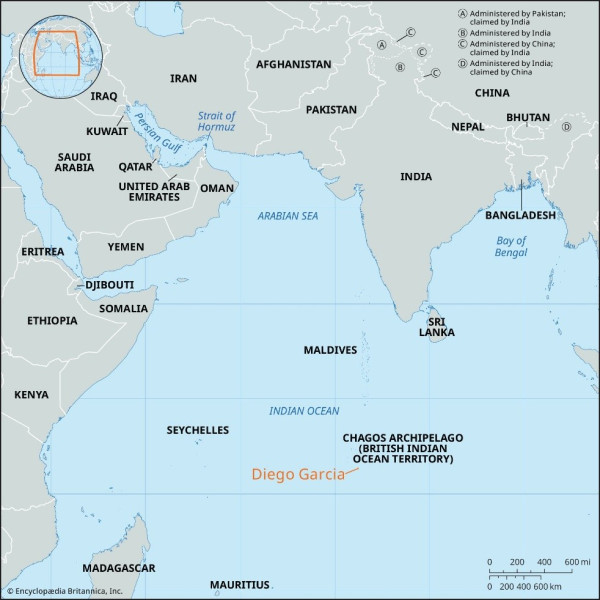
A map showing the location of Diego Garcia. (Source: https://www.britannica.com/place/British-Indian-Ocean-Territory)
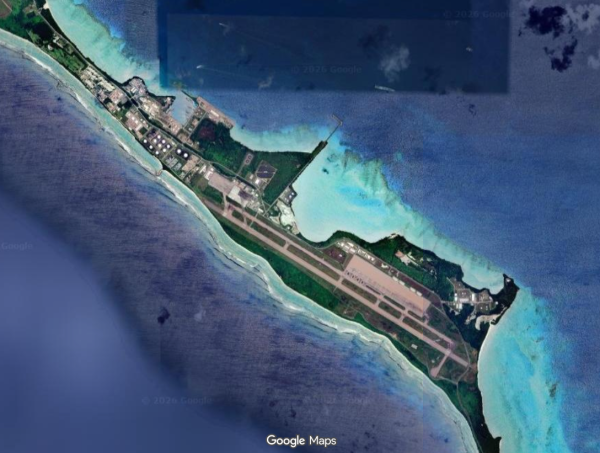
Satellite imagery showcasing the military base. (Source: Google Maps)
ENGINEERING FOR MISSION-CRITICAL FACILITIES
DMCI’s people built specialized military facilities such as the B2 Shelters for stealth aircraft, waterfront facilities within the base, ammunition support facilities, and BOSC galley, among others. The most notable part of this project was the assembly of the B2 shelters for the highly advanced B2 Stealth Bomber; this is in stark contrast to DMCI’s typical building projects.
These high-tech aircraft shelters are pre-engineered structures from Florida, USA, and are large-span fabric structures designed to house the world’s most advanced stealth aircraft, strictly built to exacting criteria to support the aircraft’s operational requirements. Because the B2 bomber’s stealth coating degrades rapidly under humidity, high heat, or moisture, the tents are all specialized climate-controlled facilities and must be rated for extreme weather conditions.
The work on the military projects shows more than just applying technical knowledge in building critical mission infrastructure is important. While there was already a set of instructions for how to assemble the tents for the B2 Bombers, after some time studying and assembling the first structure, DMCI was able to showcase the talent of Filipino engineers and workers by creating new and more efficient installation methods to the Americans for the succeeding tents.
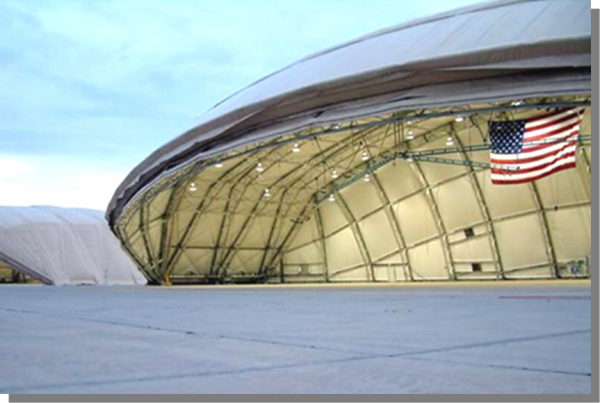
B2 Shelter – stealth bomb shelter in Diego Garcia. (Source: https://www.stripes.com/news/2003-01-16/portable-b-2-bomber-shelters-are-built-in-parts-officially-unknown-1950019.html)
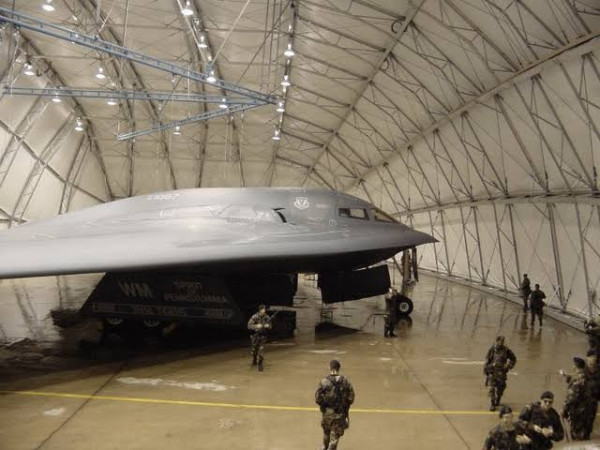
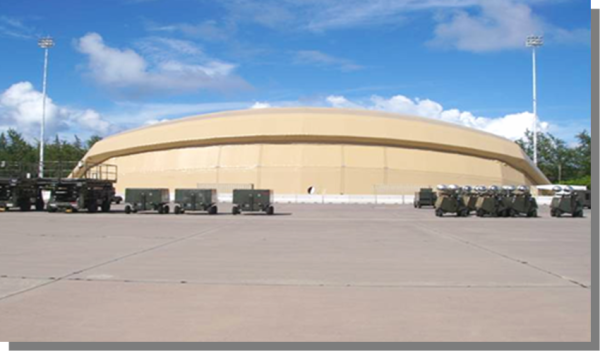
Each B2 shelter is 250 feet wide, 125 feet deep, and 60 feet high, with a total interior volume of 1.1 million cubic feet. Each shelter is cooled by 195 tons of air conditioning. This is a unique shelter system and only five shelters of this type are in existence. (Source: https://www.zianet.com/tedmorris/dg/bombers3-b2.html)
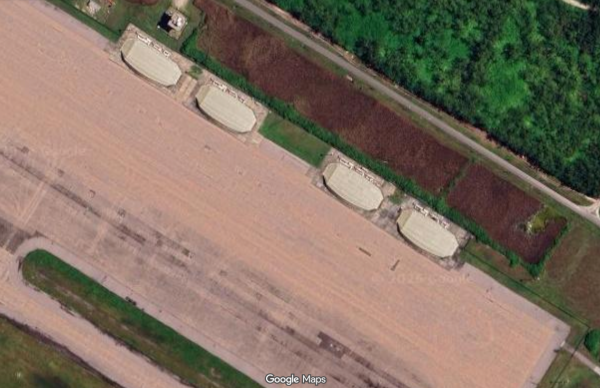
The B2 shelters can still be seen on Google Maps as of the time of posting.
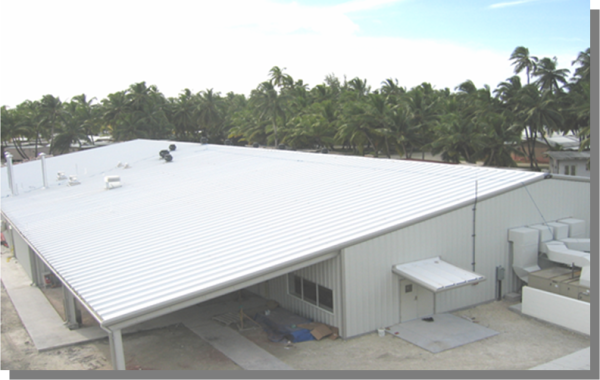
BOSC Galley
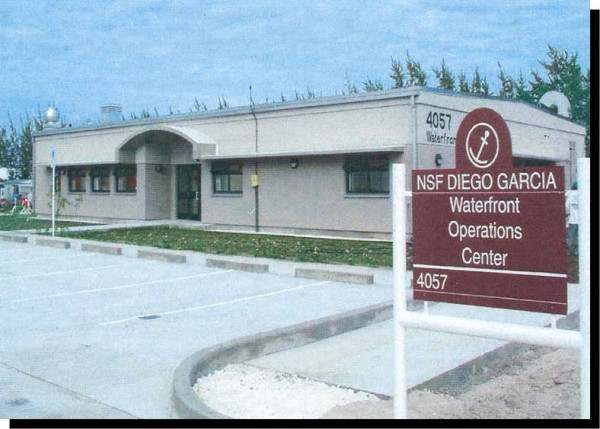
Waterfront Operations Fleet Support Facility – US$2.6 million project that have reinforced concrete footings and floors, steel girder trusses, and metal decking. The building is exterior insulation finish system, also air and water infiltration and wind load resistant.
MULTI SKILLED CONSTRUCTION IN A HIGHLY CONTROLLED ENVIRONMENT
Construction on an active military base is not like building a new commercial development. The construction process must conform to the security requirements as well as the strictly controlled document, material and personnel movement and the base’s operating procedures. Due to confidentiality issues, specifics could not be given, but the level of control and oversight required on the project was significantly more stringent than that typically encountered in ISO-conforming environments.
Every item of material, plant, and personnel required to support the construction of the new facilities on the airfield had to go through extensive clearance prior to entry on to the facility. The movement of all cargo and personnel was itself a complex problem. The fact that all flights and ship movements were under military control and fixed to a number of rigid schedules created many issues; the military often prioritized the movement of their resources and manpower, which meant DMCI’s engineers would have to wait 2-3 days before being approved to fly to the island. All flights for manpower were coursed through Singapore.
Each flight for one worker costed around 2-3,000 USD per person, round trip, for a ride in the seating area of the cargo hull of an airplane. Due to the cost, it meant that a lot of manpower could not be deployed, and came with its own set of constraints.
Normally, in Metro Manila, workers are divided into categories based on their trade; mason, carpenter, steelman, etc., and do not mix trades. However, due to the high cost of mobilization, DMCI had to bring workers and operators that knew multiple trades and equipment. A worker one day might be cutting formworks for a concrete pour, and the next day laying rebar for the structural columns of a building. This type of worker, called a “general operative” by San Juan Construction, had not yet existed before in the eyes of the Philippine Overseas Employment Administration (POEA), the government agency that manages programs for Overseas Filipino Workers. This draws some parallels to the unique challenges of construction even until today.
LASTING IMPRESSIONS
DMCI’s experience with general operatives gave it some foreshadowing of the challenges that the construction industry is facing today; namely a shortage of skilled workers. A multi-skilled worker, or general operative, does not really exist in large construction companies in the Philippines. Due to job descriptions, the scope of work for workers is clearly defined and normally do not mix between trades. However, for one example, this means that carpenters would lose productive days at work if the concreting and steelmen cannot keep up with pouring new floors. With these issues today, DMCI is applying the same concepts from their experience in Diego Garcia and actively trying to multi-skill workers so that jobsite productivity remains the same.
Even at the engineering and managerial level, creating multi-skilled construction professionals will enable them to gain more from their work and increase their potential for career development. It is important for construction professionals to understand how their scope interfaces with other trades; while a civil engineer may only be focused on concreting, they cannot forget that there are MEP conduits and stub outs that run through walls and slabs. If these are missed, one must drill through the concrete retroactively which means consulting the structural engineer and delaying the project timeline.
CONCLUSION
DMCI brings to bear more than just construction of buildings and facilities in handling very specialized projects such as the Diego Garcia project. Very specialized projects need to be operated within very strict technical and operational parameters; their logistics need to be managed very well; the various disciplines need to be coordinated very well; and the construction methods need to be adapted to the project construction conditions.
DMCI can apply its expertise in handling specialized infrastructure development projects to current high-end and critical projects for the country’s growing and strategic infrastructure development. This includes high-end and high-tech infrastructure development, requiring cutting-edge technology and mission critical facilities to be completed within strict parameters and completed on time. All of these projects are to be constructed within very controlled environments to ensure quality and require effective coordination of several engineering disciplines.
These experiences of DMCI in Diego Garcia provided valuable lessons to the company on how its engineers and construction workforce could view things from a ‘total project’ perspective. Construction workers and engineers should be able to function competently within their respective fields of expertise but also able to appreciate the inter-relationship of several systems in a project. In a project, for instance, where the structural and architectural systems are complex and interwoven, the mechanical, electrical, and other systems require equal expertise and coordination. The lesson from Diego Garcia serves as a reminder to DMCI of this crucial aspect in its construction projects.
Engineering requirements for different technologies used in various projects remain fundamentally the same: to translate given technical requirements into physical structures that are safe, efficient, and of quality. Lessons learned from Diego Garcia are relevant to DMCI’s future projects that are complex, technologically driven, and critical in nature and require high level of skills and expertise in meeting project requirements.
Watch out for our upcoming interview feature with Engr. Ronaldo R. Elepaño Jr., where he shares more firsthand insights from DMCI's experience in Diego Garcia and the lessons that continue to shape the industry today.
ABOUT THE AUTHOR
Christine Ave V. Tragura, MBA, CLSSYB
Ave is a licensed Civil Engineer with over 16 years of international engineering and infrastructure experience across the construction, oil and gas, mining, manufacturing, and energy sectors in the Philippines and Singapore. She is currently serving as Digital Communications Senior Supervisor at D.M. Consunji, Inc. (DMCI).
More News
August 14, 2026
Excellence in Action: DMCI's Successful 4th ISO Surveillance Audit
August 8, 2026
St. Luke’s Medical Center-QC New Hospital Building Project Achieves 3 Million Safe Manhours without a Lost Time Incident (LTI)
August 5, 2026
Engineering Lessons from DMCI's Experience in Diego Garcia
All News
Lessons From Diego Garcia: A Conversation with Engr. Ronaldo Elepaño Jr. August 18, 2026
Excellence in Action: DMCI's Successful 4th ISO Surveillance Audit August 14, 2026
St. Luke’s Medical Center-QC New Hospital Building Project Achieves 3 Million Safe Manhours without a Lost Time Incident (LTI) August 8, 2026
Engineering Lessons from DMCI's Experience in Diego Garcia August 5, 2026
Celebrating 5 Million Safe Manhours at the 88 MLD Las Piñas Water Reclamation Facility Project July 31, 2026
DMCI Mid-Year Planning: Reflecting on Performance, Strengthening the Path Forward July 25, 2026
Technical Insights Series Article 3 - Earthquake-Resistant Building Design in the Philippines July 13, 2026
DMCI Congratulates DLSU Laguna on Its LEED Silver Certification Milestone July 10, 2026
Amani Tower Project Achieves 1 Million Safe Manhours Without a Lost Time Incident (LTI) July 4, 2026
PHILCONSTRUCT 2026: Showcasing Leadership, Innovation, and Industry Collaboration July 3, 2026
De La Salle-College of Saint Benilde David M. Consunji Ideation Room Naming Ceremony July 1, 2026
DMCI Conducts Nationwide Simultaneous Earthquake Drill to Strengthen Emergency Preparedness June 18, 2026
Technical Insights Series Article 2 - How Megaprojects are Reshaping Philippine Infrastructure June 9, 2026
Technical Insights Series Article 1 - Structural Considerations When Designing a Power Plant May 28, 2026
DMCI Technical Insights Series May 28, 2026
La Salle Greenhills Senior High School, International Baccalaureate (IB), and Performing Arts Building Topping-Off Ceremony May 18, 2026
St. Luke’s Medical Center New Hospital Building Topping-Off Ceremony April 23, 2026
Bringing Government Services Close to Our Employees - Launching of SSS Offsite E-Center February 26, 2026
Enrique K. Razon Jr. Hall & University Hall - The country's first LEED Silver Certified Academic Buildings February 12, 2026
The new Pioneer Cold Storage is one step closer to completion! January 20, 2026
1st EHS Central Committee Meeting for 2026 January 12, 2026
Bridging the Skills Gap: Training the Next Generation of Builders November 24, 2025
DMCI is 13th GKK’s Regional Winner! October 16, 2024
DMCI successfully completes IMS recertification October 7, 2024
CIC inks P3.3-B deal with DMCI for C5 Link Segment 3B construction May 23, 2024
DMCI supports Hooked on Book (HOB) Library October 15, 2023
Continued Certification of DMCI’s Integrated Management System September 1, 2023
Continued Certification of DMCI’s Integrated Management System February 16, 2023
DMCI-Nishimatsu joint venture bags subway contract October 3, 2022
DMCI supports relief operations to typhoon-stricken areas January 9, 2022
DMCI on its way back to prepandemic profit level this year August 11, 2021
DMCI vaccinates over 4,000 employees July 9, 2021
From Ikea to Dagat-Dagatan: DMCI begins work on biggest wastewater facility March 19, 2021
Blessed Consunji Group pays it forward January 24, 2021
More than 5,000 youths to get skills training from USAID, PBEd; Aboitiz, DM Consunji to provide pre-employment support December 7, 2020
DMCI order book leaps 152% to P65.8 B in H1 August 14, 2020
Full blast construction of NLEX connector to start this year February 24, 2020
More firms eye bidding for Manila subway contracts February 24, 2020
MRP Foundation-funded PSG Station Hospital topped off February 24, 2020
DMCI Works Double Time on Infra Projects September 3, 2019
First dedicated OFW hospital, diagnostic center begins construction in Pampanga February 20, 2020
Ceremonial Track-laying for LRT Line 2- East Extension Project Package 3 April 16, 2019
Republic of the Philippines Award for Manila LRT Line 2- East Extension Project March 5, 2019