
News and Announcements
News & Announcements
Lessons From Diego Garcia: A Conversation with Engr. Ronaldo Elepaño Jr.
An interview with Engr. Ronaldo R. Elepaño Jr., Senior Business Development Advisor to the President of D.M. Consunji, Inc. (DMCI), and former President of the Philippine Constructors Association (PCA), as he looks back on the company’s experience in Diego Garcia.
A TINY ISLAND IN THE MIDDLE OF THE OCEAN
Before discussing the construction of facilities for the military, Engr. Elepaño talks about the unusual environment where DMCI’s team had to work.
“Diego Garcia is a tiny island; they call it British Indian ocean territory (BIOT) during that time.
That island was leased by the US as a military base. So, it’s basically a military base.
They call it an atoll; there’s a volcano underneath. That’s the area. The total area is 30 square kilometers.
They made it a base because it’s in the middle of the ocean.”
The remoteness of Diego Garcia formed nearly every aspect of construction on the island. The island only has air and sea transport links. This meant that getting people and materials into the island for the construction work required careful planning.
“The one who manages the area is the navy; they bring all the supplies. The major ones are by sea; the others are by air transport; they use large planes.
It was really an experience for us, for our people.”
HOW DMCI FOUND ITS WAY TO DIEGO GARCIA
DMCI was partnered with an international contractor to complete facilities on the island of Diego Garcia.
“San Juan Construction, Inc. was introduced to us by a company that we worked with, Line. Any construction in that island, you need to be working with the British. San Juan found out about Line, a British company, and Line mentioned to them that they have a partner in the Philippines (DMCI), with good workers. That’s when DMCI is introduced to San Juan. San Juan was in partnership with Line in Diego Garcia, and Line introduced DMCI to San Juan.”
The military nature of the work as well as the facilities that DMCI was constructing meant operating within an environment where access was tightly controlled.
“Our involvement here was through another US company. Because you cannot get a job here if you are not a US firm. Not just a US firm or contractor, but you are qualified by the state you are in; the security here is very heavy.”
BUILDING FOR THE B2 STEALTH BOMBER
The most notable of these is the B2 Stealth Bomber Hangar which required DMCI to learn and execute a very specialized building procedure.
“One of the jobs we did in Diego Garcia is to - stealth bombers need to have a special type of hangar. That hangar is like a big tent. We did the dismantling and installation of those tents (B2 shelter). Because they don’t have skilled workers there.”
The Filipino team under Engr. Elepaño did more than simply follow an existing procedure.
“That's basically our work for that American company; the name of the company is San Juan Construction, Inc. Through our work there, San Juan was given a certificate because we were able to improve their method in installing the tent and the shelter. Filipinos have a lot of ways.”
The work extended to other specialized facilities undertaken by DMCI on the island.
“Our other jobs aside from that are unique to our people, like the area where you store bombs or ammunitions. It's not a bomb shelter. There is also an area where you assemble the ammunitions.
Because when you store it, it's not armed. Because if you armed it already, if one explodes, everything explodes. They have another area where they do that assembly. That’s one of those we did there. We learned a lot there.”
WHEN GETTING TO THE PROJECT IS ALREADY A CHALLENGE
DMCI found out that getting to Diego Garcia was a major challenge in mobilization for the project.
“For us to go to Diego Garcia, we must go to Singapore. There is an old airport in Singapore, one they are not using commercially, that’s where this military places it. Also, the private aircraft, that’s where they land.”
Military requirements always came first.
“So that’s where we should go, and we are always wait-listed, because the priority is the military. We just go there, if there’s an available ship, that’s the only time we can go. Sometimes it takes us 2-3 days to wait.
The same thing when you depart Diego Garcia, if the plane is full because of priority, then you are bunked off, that’s their rule.”
This difficult and costly mobilization would be one of the most important lessons that DMCI brought home from the project.
“WE CANNOT AFFORD A SINGLE SKILL SET”
Diego Garcia also introduced DMCI to the concept of the workforce of general operatives.
“That's why when we brought our people there, the request of San Juan is we need to bring – the skill set required, they call it general operative.”
The term “general operative” was a term unfamiliar to DMCI then.
“When I asked what general operative is, they told me ‘When you go to that island, we cannot afford a single skill set’ in other words, multi-skilled.
You can’t be only a carpenter, a mason, a steel man, because it’s so expensive to mobilize you in and out. Also, it cannot be crowded there.”
Engr. Elepaño further adds that the lesson on the requirement for general operatives is one that will stay with DMCI forever.
“That's also the first time that DMCI realized that we need to multi-skill our people. Now were always trying to do that.”
Equally, for instance, an equipment operator would also acquire some other additional skills.
“Even operators should be able to operate more than one equipment.”
EXPLAINING A JOB THAT DIDN’T EXIST
The term “general operative” as then referred to or used, was not a recognized term or job title under the Philippine Overseas Employment Administration (POEA) rules and regulations at that time.
The difficulties of Engr. Elepaño in explaining why he required a different kind of workforce in Diego Garcia construction.
“I was asked by POEA what’s the skill is, because they set certain rates in the contract, I told them it’s general operative. They didn’t know what that was; it’s not in their list of job titles.They were trying to protect the workers, because not all companies are like us, mostly there are recruiters and might just fabricate and jeopardize the employees upon arrival.”
He explains first the project environment to the people.
“I explained it to them, and I started to show where Diego Garcia is, because you will not understand why you need a general operative until you know the location.”
How he managed his resources for the project in terms of overall logistics.
“It is not easy to send people there. Mobilization is very costly. Mobilization is studied, and the manning itself. And they want to be sure that that person could do the following. They cannot afford to wait for someone that lacks skill.”
On the other hand, a worker who is multi-skilled has greater value.
“POEA understood and they asked about the rate. Of course, I told them that the rate is higher than normal skilled workers, because of their multi-skill. But they are required to do any of the skills.
You cannot say that I am only a mason, I’m only a carpenter. That is not allowed. We need to reorient our people because they are used to being single skilled.”
WORKING INSIDE A MILITARY BASE
Engr. Elepaño said that before DMCI went to Diego Garcia, the company has already ventured into construction in military facilities like Subic and Clark. He said that normally, the operation of the military is not the same with other sectors of the industry. He explained that for instance, construction for the military is never on going as it is for other clients. Construction activities are put on hold by the military when operation requires it to cease.
“This is not the only military base we worked on, except this is the one outside the Philippines. But here, we worked with Subic and Clark.”
DMCI's experiences while constructing in Subic and Clark were highly relevant in terms of getting used to the military environment of a military base such as Diego Garcia. And as Engr. Elepaño stated earlier, even within a normal construction site within a military facility, the construction force has to be aware of when normal construction practices can no longer be adhered to.
“It’s always written in the contracts, they can stop you anytime, especially with an emergency, they will take over the area, but you will be compensated.
You are to follow a lot of rules. Just like when you drive in Subic, similar to that. If you are not used to certain restrictions and you suddenly enter an environment like that, it will be difficult.”
Documentation was equally demanding.
“And of course, doing contracts with ROICC, there’s a lot of documentation. Practically, you must stay in America to get our materials which are all made in America.
Working in a base is different, both on safety, on the rules, and the immediate stoppage whenever they need the base.”
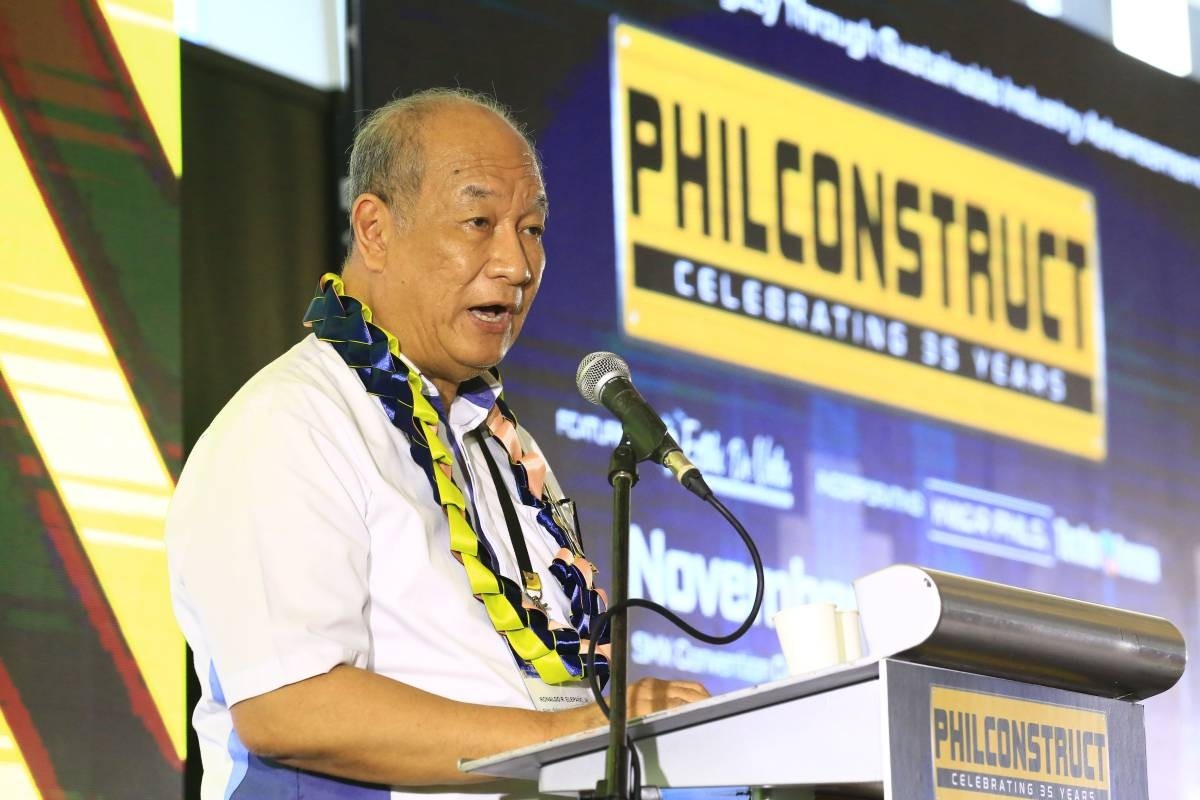
Engr. Ronaldo R. Elepaño Jr., former President of the Philippine Constructors Association (PCA) delivers his speech during the 35th anniversary celebration of Philconstruct 2024. (Source: https://www.manilatimes.net/2024/11/07/photos/philconstruct-anniversary/1999800)
WHY ALL THAT DOCUMENTATION MATTERS
The DMCI people were able to draw on their experiences at Diego Garcia because they worked on military bases prior to this such as their Subic and Clark projects.
“In the beginning, it was quite difficult. But since we have that experience in Subic and Clark, we already know the requirements; that’s an advantage.
Our advantage is that we have worked in a military base before. Some of our people already know what to expect. And even those who have no experience there, those who are seniors, have a lot of reminders on how to do things.”
It was only later on when they were on the project that he realized why they went through all the stringent procedures and documentation required by the military facilities.
“And I think also, our experience in the bases also helps shape how we do our work. First, you’ll think it’s too difficult, there are a lot of documentations, but if you look at it carefully, you will realize it is really needed. Especially if you want ISO, it’s all documentation. In a way, we are lucky that we have had that experience before.”
And for Engr. Elepaño, experience only becomes valuable if it is passed down.
“That's what the 1st and 2nd generation should download for the 3rd generation, our experiences before.”
“MULTISKILLING. THAT'S THE BEST LESSON WE LEARNED.”
To answer the question on which lesson can be implemented in future projects within DMCI, Engr. Elepaño's answer was immediate:
“Multiskilling. That's the best lesson we learned, and even now, it applies.”
Earlier he had mentioned that multi-skilling the personnel for Diego Garcia was for logistics reasons. But the biggest lesson that DMCI learned from Diego Garcia was multi-skilling the personnel and this has so much broader application now than it did before.
“In Diego Garcia, it was more of a necessity, because your logistics has certain constraints. But now, we see that this really needs to be more efficient in your work; and also, to give more opportunities to workers for a longer duration.
If they have more skills, they will not be terminated; you can shift from one to the other.”
Multi-skilling is also an advantage to Filipino workers as they compete internationally.
“Second, when they find out overseas that you are that good, they will hire you, because they won’t need to mobilize for different skills and they can pay you even higher.”
Multi-skilling cannot be forced upon the worker.
“Before you start training them for multi-skilling, explain them because you must motivate them. That’s the problem with our people, his behavior, where he places himself is not aligned. He thinks that I’m only going to do this; you must compensate me. They don’t see the bigger picture.”
Another important factor is that another skill is good for the worker as well as for the company.
“If you just train them without any explanation, they will question why they are doing a lot of things that are not their usual job.
If they start saying that it’s not their job, it’s a dead end, they will not want to learn.”
“THAT IS THE FUTURE, LIFE-LONG LEARNING.”
Engr. Elepaño emphasized earlier that multi-skilling is the future of construction. It ultimately points toward something bigger: continuous learning.
“Times have changed, and nowadays, if you don't pursue learning, you will be left behind.
That is the future, life-long learning. It can’t be that once you’re done, you’re done. That’s the biggest lesson.”
The lessons learned in Diego Garcia is so relevant to what is happening today, with the lack of workforce and lack of right skills of the workers that are available to be deployed for construction work.
“The first time I heard of general operative, multi-skilling, and now, some other contractors are already doing it. India is a real threat because they want to be the skill capital of the world, because their mindset is different. But still, that’s the lesson learned in Diego Garcia, multi-skilling. And now, were realizing we must do it, and that was how many years ago. If we had already continued multi-skilling during that time, we would be the most efficient company here. Now were just starting and even having problems with how to compensate the workers, if we focus on that, we would be left behind.”
His conviction remains strong:
“Whoever goes multi-skilling will definitely go ahead.”
He believes that Filipino workers have the ability to adapt to the demands of the construction industry and its challenges.
“During the early days it was very difficult to hire, fire, hire, and fire. The documentation is really hard. Multi-skilling, people may not see it yet, but ultimately it must be done. That's where were heading. Us Filipinos, I think we can really do. We have co-citizens in other countries where they are all around, he’s a carpenter, plumber, drives a van, he can manage well. That’s why I think we must promote that. Lessons learned from Diego Garcia, multi-skilling. That’s what we need to show in this industry.”
THE FILIPINO WORKFORCE
The experience in Diego Garcia further reinforced his admiration of the Filipino worker’s ability to function effectively in demanding situations.
“Filipinos obeys everything. I’ve seen it, we’ve been to Diego Garcia, Dubai, Brunei, and UK. Once given the set of rules, they follow. Of course, not everybody, there are exceptions, but generally.
And they want to excel also.”
Qualifying construction workers before they can be mobilized to remote sites like Diego Garcia is very important. Misusing workers’ skills in a remote place is very costly.
“In Diego Garcia, we made a certain procedure to find out who is really qualified, before we send them. Because it’s difficult to send the wrong person due to it being costly. At that time, the airfare was around 2,000-3,000 USD, because it was a special flight.”
The conditions were far from luxurious.
“It’s not even first class; you just join the cargo.”
Engr. Elepaño shared some of the lessons he learned from the Filipino workers he worked with during his time at Diego Garcia. The workers’ attitude towards work and their ethics were very good.
“During that time, the Filipinos are really giving their best, that’s the beauty of it. They know they are going there; they will really show you their excellent workmanship.
Also, when they reach there, they are very hardworking.”
THE FUTURE OF CONSTRUCTION STILL COMES BACK TO SKILLS
Engr. Elepaño believes even after the Diego Garcia experience years have passed, the challenge of the industry’s workforce developing multi-skilling even more needed.
“If there’s one lesson, it’s really multi-skilling. The only problem during that time is that it is not yet appreciated. And i think there are still a lot of skills available. Because when you multi-skill, their question is ‘then others would not have anything to do anymore?’ The effort to do multi-skilling during that time was not that in demand, because there are too many skills.”
Today, the environment is different.
“But now there is difficulty, the complaint always is skills. Skills gap, skills mismatch, everything.”
For him, develop people who are serious about making a career in the construction industry and develop their capabilities.
“I suggested that we only multi-skill only those who are interested. The problem with construction now is very few want to stay.
The ones that really want to stay in construction, that’s who i will teach. I won’t waste time, only to those who wants to stay with us.”
Capable individuals will provide opportunities for good compensation.
“That's why we want to go multi-skilling, to give them more opportunities, so we can raise their salary.
We told them that pay is not a problem, the problem is proficiency, productivity, and quality of work. If you can show me that it becomes higher, I can give you higher pay.”
For construction, productivity remains fundamental.
“It’s like that in construction, because we base our estimate based on your productivity and quality of work. If it is said that you can do this and you are not able to do it, then we will get in trouble. First step is overtime, if overtime can’t do it, additional manpower, that’s it. So, what is the solution? Improve his skill, that’s the only way.”
PEOPLE, SKILLS, AND AI
Technologies will not replace the development of people in the construction industry but will change how the industry operates.
“People say use AI. Not yet, maybe if there is a robot beside you, not everything can be programmed in AI.
They think that the big solution is in AI. I tend to disagree. Maybe, but not now. My solution is multi-skilling.”
That does not mean rejecting the technology.
“But AI, yes, AI will help, as a tool, not replace people.”
Engr. Elepaño says that the core construction problem in terms of people and technology is a simple one:
“JAC’s question is: who will install? AI?” (JAC - Jorge A. Consunji, D.M. Consunji, Inc. (DMCI) President and CEO)
It seems the lesson from Diego Garcia can be equated to this simple construction question as well:
“If you ask that question, you will understand that not everything can be AI. People always talk about AI, and they pin their hopes in AI. Unfortunately, AI will not answer everything.”
A LESSON THAT STARTED IN DIEGO GARCIA
Engr. Elepaño recalls in this interview how he still remembers the lesson that he learned in the construction works of Diego Garcia years ago.
“That's why I’m passionate about multi-skilling, because we saw it, how can you improve productivity? If a person is good at one skill, and another person is good at different skills, who will you choose? The fact that you want to give him a job, but because he only knows this, what can you do? If that piece of work is already gone. For our administration, there would be lesser problems. You will only hire and terminate him once. It’s important that everybody accepts it. They must buy in, the multi-skilled, our HR admin, our project engineers, everybody. That’s all we need.”
And his message for the industry remains straightforward:
“Multiskilling. That's the best lesson we learned, and even now, it applies.”
“That is the future, life-long learning.”
“Multi-skilling, people may not see it yet, but ultimately it must be done. That's where were heading.”
ABOUT THE AUTHOR
Christine Ave V. Tragura, MBA, CLSSYB
Ave is a licensed Civil Engineer with over 16 years of international engineering and infrastructure experience across the construction, oil and gas, mining, manufacturing, and energy sectors in the Philippines and Singapore. She is currently serving as Digital Communications Senior Supervisor at D.M. Consunji, Inc. (DMCI).
More News
August 14, 2026
Excellence in Action: DMCI's Successful 4th ISO Surveillance Audit
August 8, 2026
St. Luke’s Medical Center-QC New Hospital Building Project Achieves 3 Million Safe Manhours without a Lost Time Incident (LTI)
August 5, 2026
Engineering Lessons from DMCI's Experience in Diego Garcia
All News
Lessons From Diego Garcia: A Conversation with Engr. Ronaldo Elepaño Jr. August 18, 2026
Excellence in Action: DMCI's Successful 4th ISO Surveillance Audit August 14, 2026
St. Luke’s Medical Center-QC New Hospital Building Project Achieves 3 Million Safe Manhours without a Lost Time Incident (LTI) August 8, 2026
Engineering Lessons from DMCI's Experience in Diego Garcia August 5, 2026
Celebrating 5 Million Safe Manhours at the 88 MLD Las Piñas Water Reclamation Facility Project July 31, 2026
DMCI Mid-Year Planning: Reflecting on Performance, Strengthening the Path Forward July 25, 2026
Technical Insights Series Article 3 - Earthquake-Resistant Building Design in the Philippines July 13, 2026
DMCI Congratulates DLSU Laguna on Its LEED Silver Certification Milestone July 10, 2026
Amani Tower Project Achieves 1 Million Safe Manhours Without a Lost Time Incident (LTI) July 4, 2026
PHILCONSTRUCT 2026: Showcasing Leadership, Innovation, and Industry Collaboration July 3, 2026
De La Salle-College of Saint Benilde David M. Consunji Ideation Room Naming Ceremony July 1, 2026
DMCI Conducts Nationwide Simultaneous Earthquake Drill to Strengthen Emergency Preparedness June 18, 2026
Technical Insights Series Article 2 - How Megaprojects are Reshaping Philippine Infrastructure June 9, 2026
Technical Insights Series Article 1 - Structural Considerations When Designing a Power Plant May 28, 2026
DMCI Technical Insights Series May 28, 2026
La Salle Greenhills Senior High School, International Baccalaureate (IB), and Performing Arts Building Topping-Off Ceremony May 18, 2026
St. Luke’s Medical Center New Hospital Building Topping-Off Ceremony April 23, 2026
Bringing Government Services Close to Our Employees - Launching of SSS Offsite E-Center February 26, 2026
Enrique K. Razon Jr. Hall & University Hall - The country's first LEED Silver Certified Academic Buildings February 12, 2026
The new Pioneer Cold Storage is one step closer to completion! January 20, 2026
1st EHS Central Committee Meeting for 2026 January 12, 2026
Bridging the Skills Gap: Training the Next Generation of Builders November 24, 2025
DMCI is 13th GKK’s Regional Winner! October 16, 2024
DMCI successfully completes IMS recertification October 7, 2024
CIC inks P3.3-B deal with DMCI for C5 Link Segment 3B construction May 23, 2024
DMCI supports Hooked on Book (HOB) Library October 15, 2023
Continued Certification of DMCI’s Integrated Management System September 1, 2023
Continued Certification of DMCI’s Integrated Management System February 16, 2023
DMCI-Nishimatsu joint venture bags subway contract October 3, 2022
DMCI supports relief operations to typhoon-stricken areas January 9, 2022
DMCI on its way back to prepandemic profit level this year August 11, 2021
DMCI vaccinates over 4,000 employees July 9, 2021
From Ikea to Dagat-Dagatan: DMCI begins work on biggest wastewater facility March 19, 2021
Blessed Consunji Group pays it forward January 24, 2021
More than 5,000 youths to get skills training from USAID, PBEd; Aboitiz, DM Consunji to provide pre-employment support December 7, 2020
DMCI order book leaps 152% to P65.8 B in H1 August 14, 2020
Full blast construction of NLEX connector to start this year February 24, 2020
More firms eye bidding for Manila subway contracts February 24, 2020
MRP Foundation-funded PSG Station Hospital topped off February 24, 2020
DMCI Works Double Time on Infra Projects September 3, 2019
First dedicated OFW hospital, diagnostic center begins construction in Pampanga February 20, 2020
Ceremonial Track-laying for LRT Line 2- East Extension Project Package 3 April 16, 2019
Republic of the Philippines Award for Manila LRT Line 2- East Extension Project March 5, 2019